




From eKYC to Account Opening: A Complete Mobile Enrollment Workflow
This quarter, thousands of accounts were opened by your correspondent network. In reality, how many of them are in use?
India’s account-activity data indicates that dormancy is more than twice as high as the global average, making account activation an important part of the onboarding process.
The challenge often begins at the point of account creation. A field agent may stand outside a customer’s home in a village 40 kilometers from the closest branch with a stack of physical KYC paperwork and a laptop bag, hoping the customer had photocopies of their PAN and Aadhaar ready. If a document is smeared or a signature doesn’t match, the account opening is delayed until the next visit, and by then, the customer has frequently moved on.
When you multiply that by the number of correspondent networks attempting to reach hundreds of millions of underserved clients, “customer onboarding” becomes a logistical challenge as much as a customer experience issue.
Mobile eKYC addresses this gap by moving key account-opening and KYC activities from the branch to the customer’s location. The workflow can cover biometric capture, biometric capture, identity authentication, document and liveness capture, structured data transmission and account activation.
This article explains the complete mobile enrollment workflow, the role of field hardware, and the key factors organizations should evaluate before deploying a mobile eKYC solution.
Why Does Branch-First Onboarding No Longer Scales?
Branch first onboarding becomes difficult when customers live far from physical banking locations. It is not possible for bank branches to be available at every location where a new customer needs access to financial services. With the right equipment, a banking correspondent can extend that reach.
India’s financial inclusion statistics demonstrate impressive growth, but they also reveal a very particular and easily resolved issue. The World Bank’s 2025 Global Findex study states that:
- Financial account ownership in India climbed to 89% in 2024, up from 77.5% in 2021 and just 35% in 2011 one of the sharpest inclusion curves the report has tracked anywhere in the world.
- Nearly 90% of both men and women in India now hold an account, and South Asia as a region has crossed 80% account ownership.
- The percentage of Indian account holders who had not utilized their accounts in the previous 12 months was 16%, which is more than double the global average.
- Over half of the world’s 1.3 billion unbanked adults are located in only eight nations, including India.
When everything is considered, it becomes evident that account ownership was never the true bottleneck. They are activation, re-verification, and truly usable access when needed. That’s when branch-anchored onboarding starts to fail, and it’s a workflow issue rather than an awareness issue. A branch cannot be in every location where a new customer is. With the proper equipment, a banking correspondent can be.
What Regulatory Framework Supports Mobile eKYC?
For many years, compliance requirements were a major consideration for field based account opening. Recent regulatory developments have provided greater clarity around assisted, field-based KYC activities.
The RBI’s KYC (Amendment) Directions, 2025
This amendment specifically gave Business Correspondents the authority to accept customer self-declarations for address-only or no-change KYC updates, as long as the declaration is electronically recorded following a successful biometric-based eKYC verification. These declarations must now be digitally recorded, authenticated in the field, and sent into core banking systems by banks via their BC systems.
This is built upon the already established Aadhaar eKYC framework, which includes OTP-based, biometric-based, and offline XML verification in addition to the Video-based Customer Identification Process (V-CIP), which is seen by the RBI as being on par with in-person verification.
The RBI released sector-specific KYC Master Directions in November 2025 for ten different types of institutions, including commercial banks, NBFCs, payments banks, cooperative banks, and more. These guidelines provided each category with more precise operational guidelines for this form of assisted, field-based enrollment.
In practical terms, the regulatory framework supports field-based KYC activities when the prescribed verification, authentication, recording, and transmission requirements are met. The operational challenge is ensuring that the hardware and field workflow can excuse those requirements reliably.
What Does a Complete Mobile Enrollment Workflow Include?
A mobile eKYC workflow is more than capturing a fingerprint and verifying it against Aadhar.
A complete mobile enrolment workflow typically includes five stages:
- Identity capture in the field.
- Document & Liveness Capture
- Structured data transmission
- Account activation
- Live authentication against identity source
Each of these stages can introduce a potential point of failure if the workflow or equipment is not designed for field conditions.
Identity capture in the field
Identity capture is the first critical stage because the quality of biometric data affects everything that follows.
A low quality fingerprint capture can slow down entire enrollment and may result in an authentication mismatch that requires the customer to repeat the process.
This can become a significant issue during rural and semi-urban enrollment drives. For this reason, biometric devices used for field enrollment need to meet established image quality and certification requirements rather than relying on basic consumer grade scanning.
Live authentication against the identity source
The next stage involves real-time identity authentication.
Depending on the workflow, this may include Aadhar biometric or face authentication, OTP-based eJYC, or a V-CIP video interface.
Because these activities may take place outside a branch, the field device needs dependable connectivity. Based on the deployment, this can either be 3G, 4G, WiFi, and GPS tagged location confirmation for audit purpose.
Document & Liveness Capture
Mobile enrollment may also require photographs, signatures and supporting KYC documents to be captured and quality checked at the customer’s location.
An integrated high resolution camera with adequate flash performance can help agents capture usable documents and photographs under changing field light conditions.
Capturing and checking these inputs immediately can reduce the need to collect documents first and review them later.
Structured data transmission
Captured biometric data, documents, documents, self declarations and geotags must reach the bank’s main systems in the required format.
Standard image formats such as WSQ and JPG2000, along with ISO/IEC 19794 standards and NIST compliant quality checks where applicable, can support consistent capture and reduce downstream reconciliation work.
The objective is straightforward: capture usable data at the source & transit it in a structured format that fits the institution’s workflow.
Account Activation, not just account creation
The mobile enrollment workflow should not necessarily end once KYC is completed.
India’s account dormancy figures make account activation an important consideration. When an account is created & used during the same visit, the field workflow can move beyond account creation toward actual financial access.
Depending on the institution & usecases, this may include an initial deposit, UPI registration, or an AePS-linked payment.
The goal of mobile eKYC is therefore not only to create an account. It is to support a complete path from customer identification to usable financial access.
Why Does the Field Device Mobile eKYC Outcome?
The Field device directly affects the quality & reliability of the enrollment process.
Remember, a well designed eKYC software stack cannot compensate for poor quality of biometric capture or a device that cannot remain operational throughout a full day.
This becomes especially important when enrollment takes place at a customer’s doorstep, a temporary camp or hard to reach locations where there is inconsistency in electricity and connectivity.
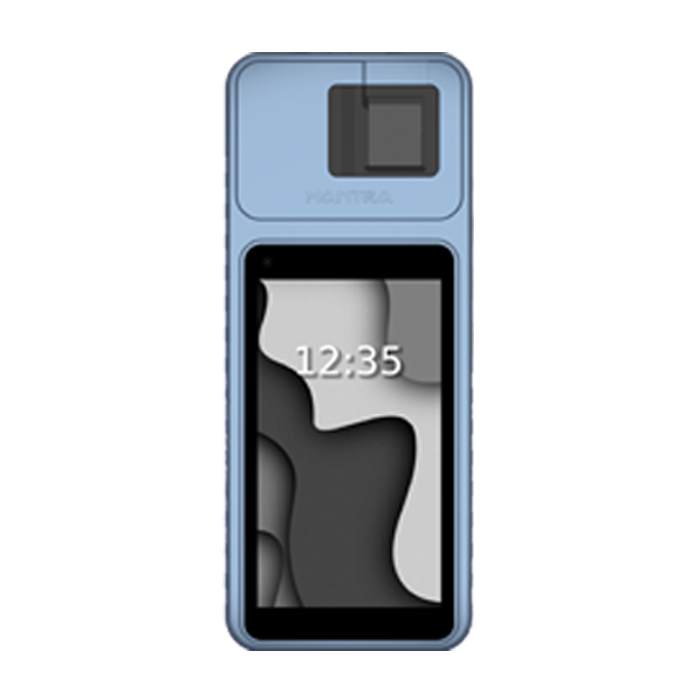
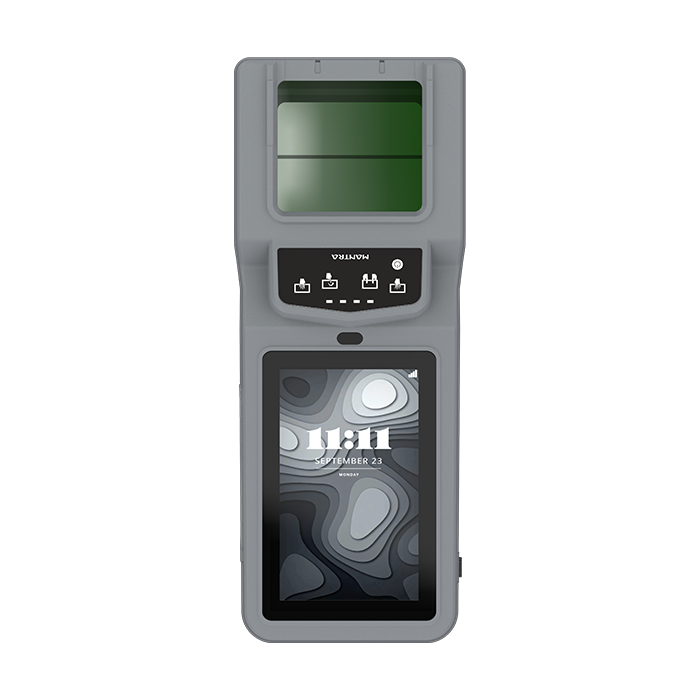
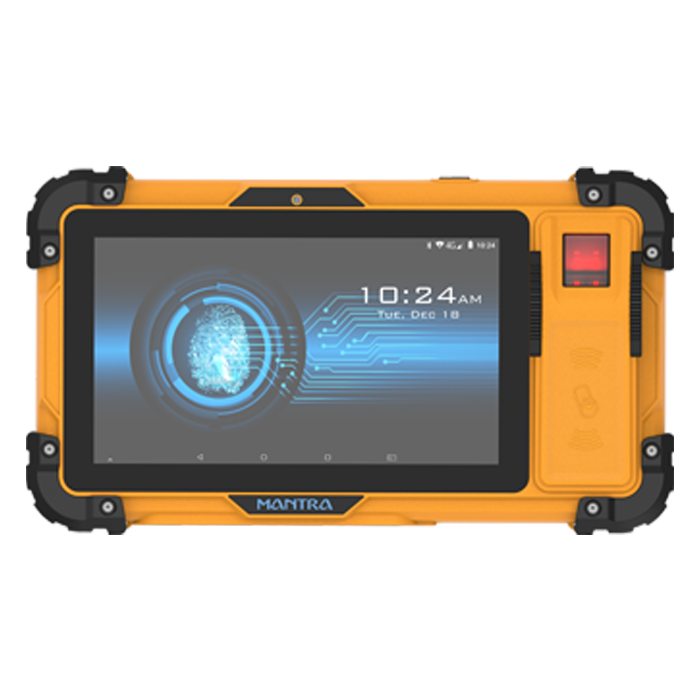
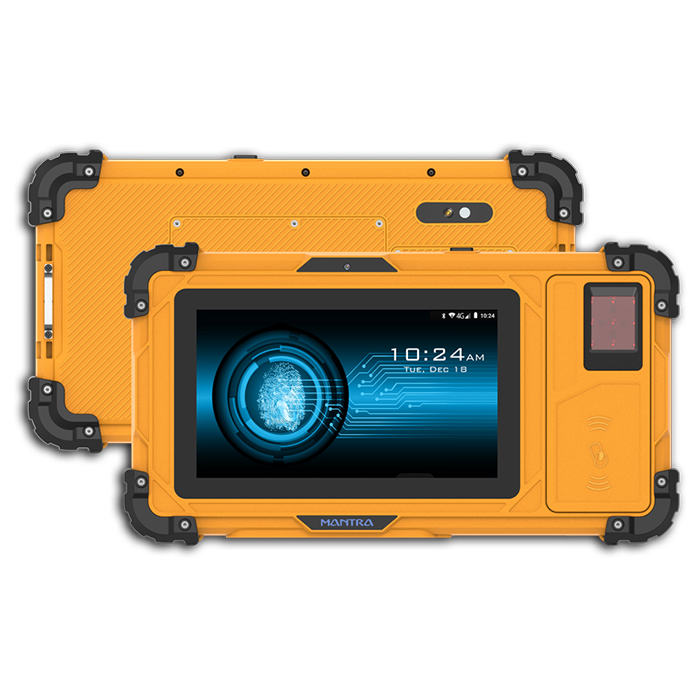
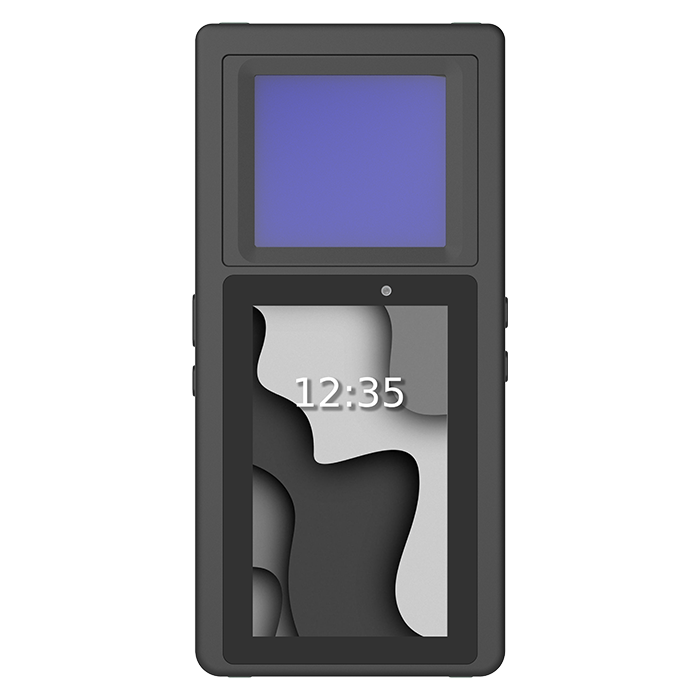
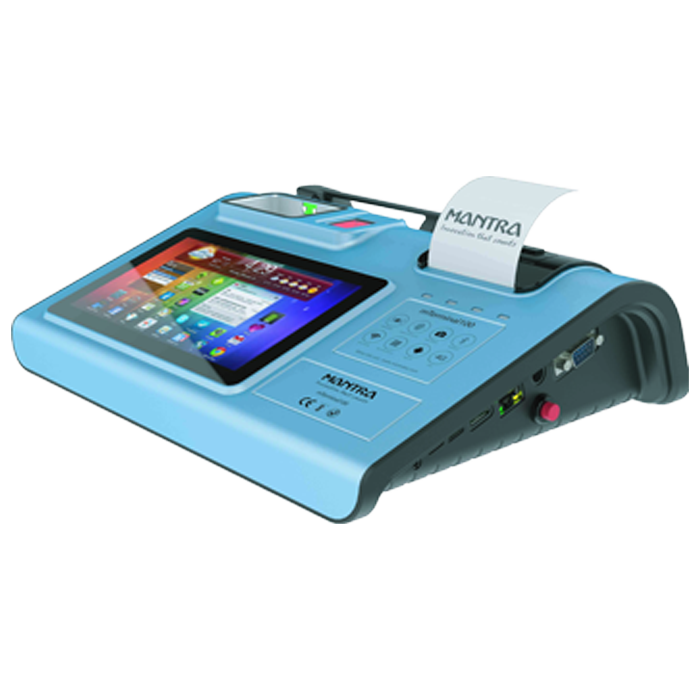
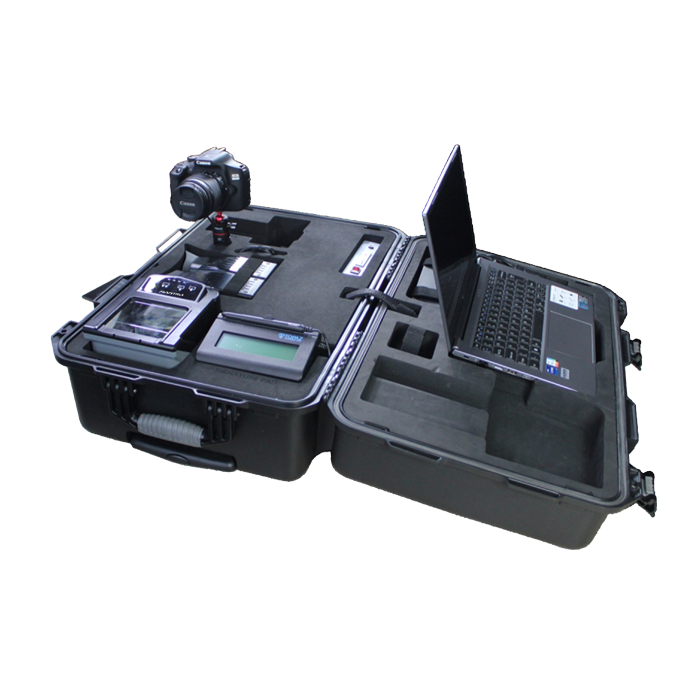
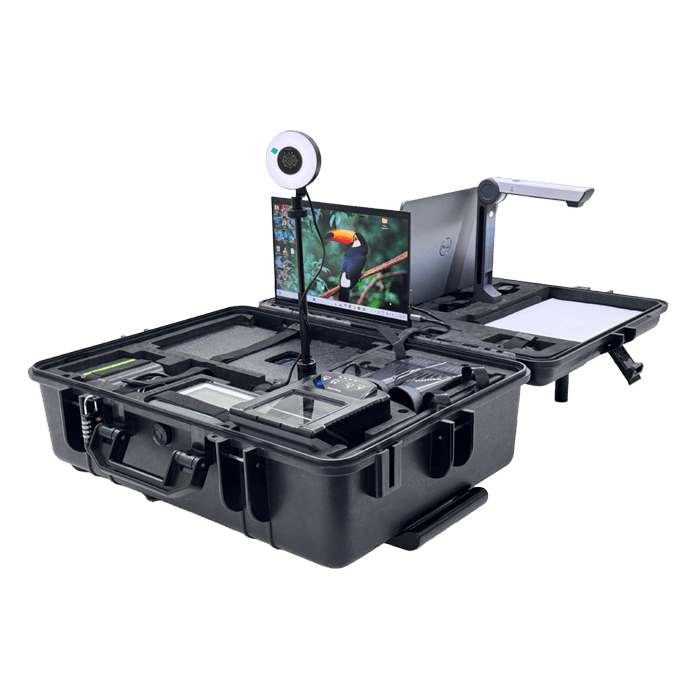
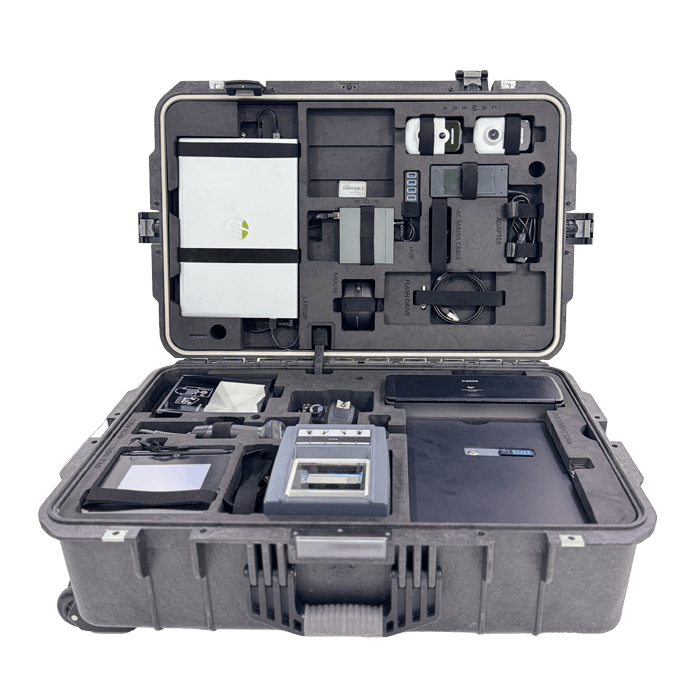
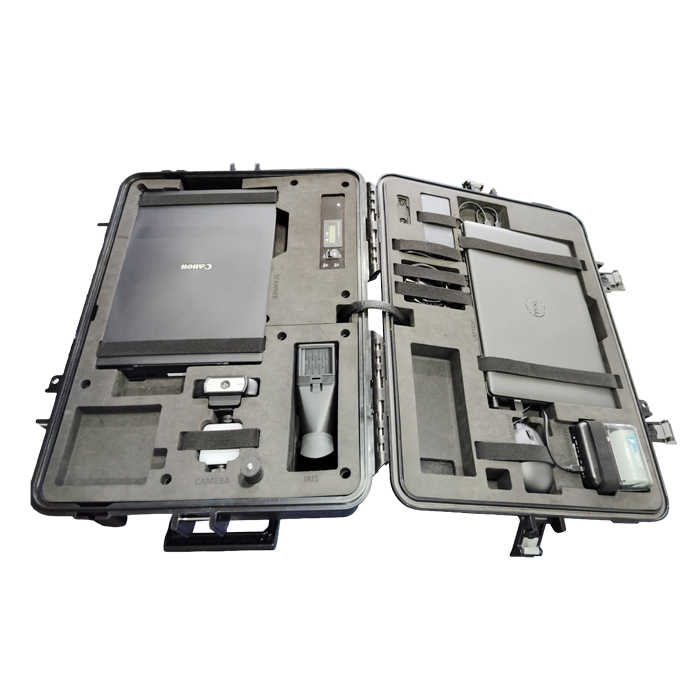
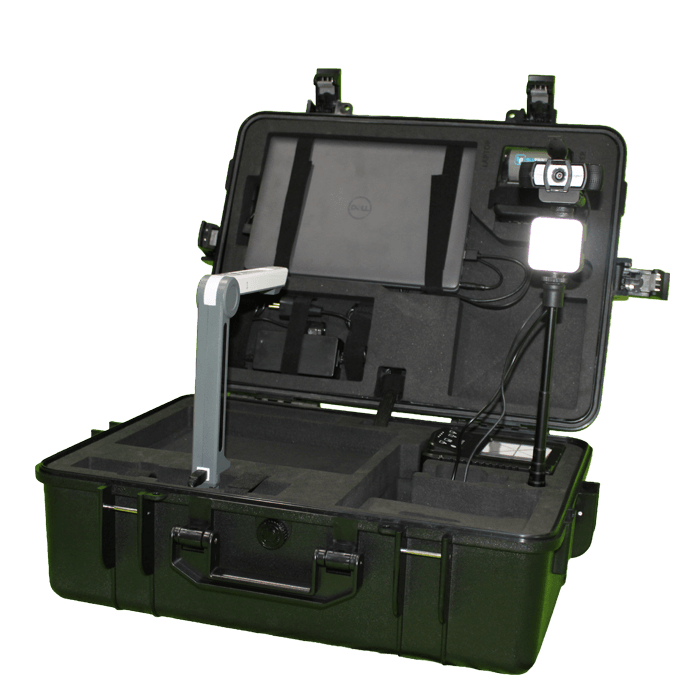
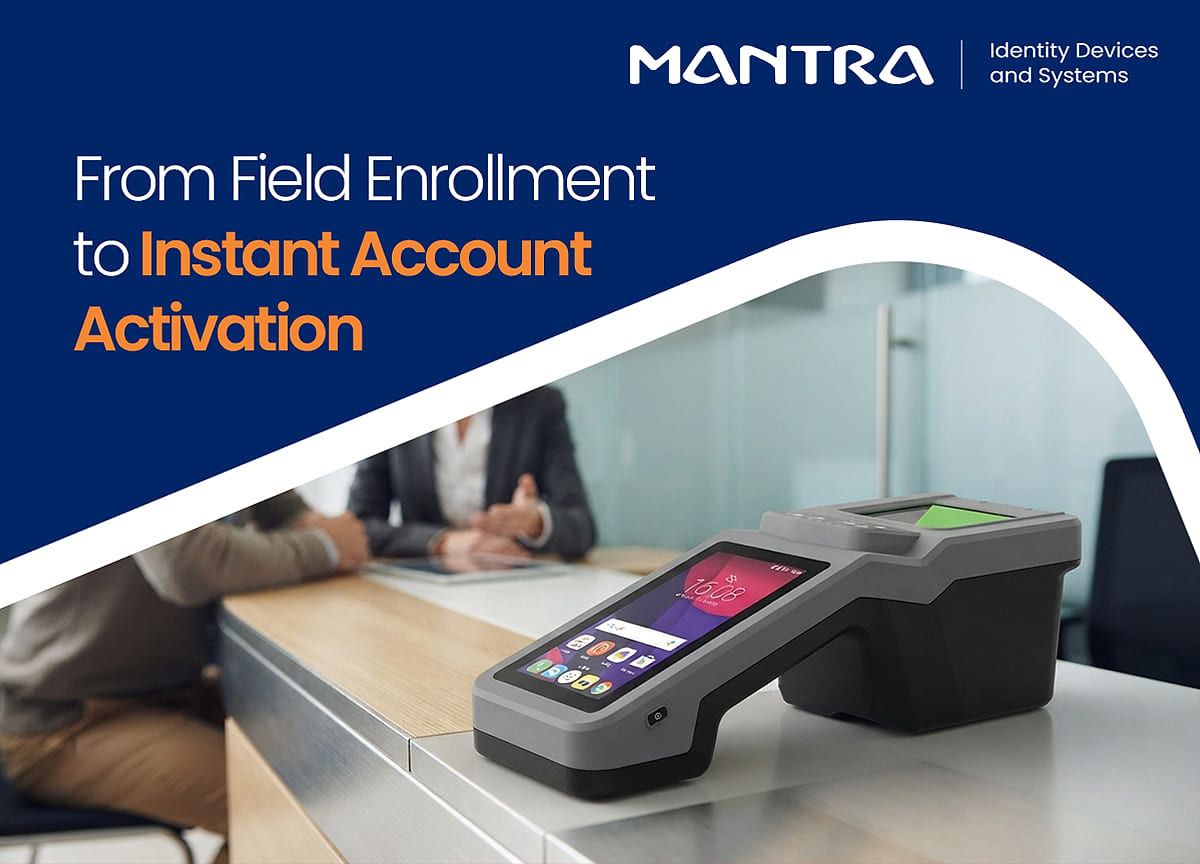
Mantra Identity Devices and Systems’ MOXA 7e portable biometric enrollment terminal, is designed to fill this particular niche. Instead of seeing its specs as a list of characteristics, it is worthwhile to explain how each one directly relates to the process stages mentioned above.
- Customers won’t be required to verify twice thanks to the FBI FAP 60-certified, 500 DPI optical sensor’s NIST-compliant quality checks and clean capture on the first try.
- When an agent processes dozens of enrollments every day, the ability to compress multi-step enrollment into a single seamless interaction of ten-finger slap and dual-thumb capture in one scan is crucial.
- From doorsteps to tents to inside counters, an 8MP autofocus camera with a high-brightness flash provides dependable document and photo capture in changeable field illumination.
- Even in areas with sporadic connectivity, 4G/3G/2G, dual-band Wi-Fi, Ethernet, Bluetooth, and GPS maintain real-time authentication and generate geotagged, audit-ready records.
The hardware does not replace the compliance workflow defined by the application KYC requirements. Instead, it provides the physical capabilities needed to execute that workflow at the customer’s location.
Where Is Mobile eKYC Used?
Mobile eKYC and field-based enrollment can support several financial inclusion and customer onboarding use cases.
- With the 2025 amendment giving BCs official authority to manage biometric-authenticated self-declarations and KYC updates, banking correspondents are expanding branch reach. As a result, correspondent networks are evolving from a workaround to a compliant, primary onboarding conduit.
- Doorstep banking for rural and semi-urban clients: According to UIDAI, the Aadhaar-enabled Payment System facilitates over 400 million last-mile transactions each month, demonstrating the high usage of the last-mile transaction infrastructure. The chance is to expand that same reach beyond withdrawals to include complete account origination.
- Field verification for lending and insurance onboarding: NBFCs and insurers doing doorstep application verification are subject to the same connectivity and capture-quality limitations as banks, plus the additional burden of preventing fraud at initial contact.
- Enrollment in government and welfare-linked accounts: Camps and drives that are connected to the distribution of subsidies and benefits require enrollment volumes that are significantly greater than what any branch counter can do in a similar time frame.
The Economics Makes the Case on Their Own
The cost curve is as follows if the hardware and compliance justifications are insufficient:
- According to India’s 2024 Economic Survey, the cost of performing an eKYC check decreased from approximately ₹1,000 to less than ₹6 per verification, a drop from roughly $12 to 6 cents thanks to Aadhar enabled digital infrastructure.
- UIDAI recorded more than 221 crore, or 2.21 billion, in August 2025 alone, there were 18.6 crore Aadhar authentication transactions, 10 times more than during the same month the year before.
The infrastructure is already in place and expanding to support authentication at this size. The ability of an institution’s own field workflow device, connectivity, and procedure to keep up with it is what determines whether it takes advantage of its fair portion of that inclusion opportunity.
What Should Organizations Evaluate Before Deploying Mobile eKYC?
Before beginning a field test, organizations evaluating a mobile enrollment rollout should consider four key questions:
-
Does the biometric device meet recognized quality standards?
The term “biometric enrolment device” can be used broadly. Organizations should determine whether the device has been evaluated against relevant FAP or NIST benchmarks and whether its biometric capture hardware meets the required quality & certificate standards.
-
Can the device operate through a full field day?
Rural and semi-urban enrollment may involve long routes and limited access to charging facilities.
Battery performance should therefore be evaluated under actual field conditions rather than only under controlled testing environments.
-
Does the workflow activate the account during the same visit?
Account creation does not automatically translate into account usage.
Given the account dormancy data, organizations should evaluate whether their workflow can move from KYC completion to account activation & initial financial activity during the same customer interaction where appropriate.
-
Is the workflow aligned with current KYC requirements?
The mobile enrollment process should be assessed against applicable sector specific KYC requirements and the RBI’s 2025 provisions relating to business correspondents.
This can help organizations build a field workflow that does not require major redesign when compliance requirements are reviewed or updated.
Conclusion
India has made significant progress in expanding account ownership. The next challenge is ensuring that accounts become active, usable, and accessible to customers who may live far from traditional banking infrastructure.
A complete mobile eKYC workflow addresses this challenge by bringing biometric identity capture, authentication, document verification, structured data transmission, and account activation closer to the customer.
For organizations planning a field enrollment rollout, the key question is therefore not simply whether an account can be opened outside a branch. It is whether the complete workflow, from biometric capture to account activation, can operate reliably in the conditions where customers actually live and work.